
Why Your "Bad Hardwood Floor" Is Actually a Subfloor Problem (And What It Takes to Fix It)
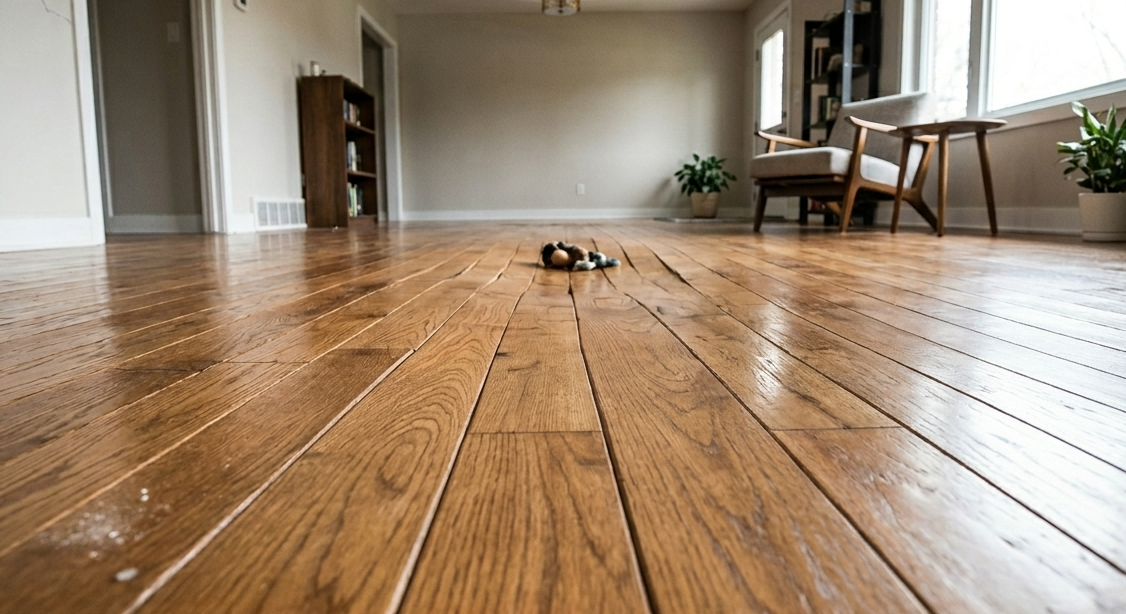
Your hardwood floors have gaps between planks that weren't there six months ago. Or they squeak with every step. Or certain boards feel bouncy and unstable underfoot. You're convinced the installation was done poorly or the materials were cheap, and you're researching contractors to rip it out and start over.
What looks like a floor problem is sometimes a seasonal stress problem — here's how winter weather damages hardwood floors in Pennsylvania and how to tell the difference between weather damage and a structural issue.
Before you spend $15,000+ on replacement hardwood, you need to understand something critical: the problem probably isn't your hardwood floor. It's what's underneath—sagging floor joists, uneven subfloors, moisture-damaged sheathing, or construction shortcuts that have been hiding beneath your flooring for decades.
One of the most common scenarios we encounter after pulling up carpet is original hardwood that's refinishable — here's how to save $5,000 to $10,000 by refinishing the hardwood under your carpet instead of installing new.
After 20+ years installing and refinishing hardwood throughout Bucks County, Montgomery County, and Philadelphia, we've diagnosed hundreds of "flooring failures" that were actually structural issues. Homeowners are understandably frustrated when beautiful hardwood develops problems, but installing new flooring over bad subfloors guarantees the same problems will reappear—often within months.
Here's how to identify subfloor and joist problems, what causes them in Pennsylvania and New Jersey homes, and what it actually takes to fix them properly.
Understanding the Structure Beneath Your Hardwood
Hardwood flooring is the visible surface, but it's only the top layer of a multi-component floor system. Understanding what's beneath helps you identify where problems originate:
Floor joists: Horizontal structural beams (typically 2x8, 2x10, or 2x12 lumber) that span between foundation walls or support beams, spaced 16" apart in most residential construction. Joists carry the weight of everything above them—floors, furniture, people.
Subfloor: Sheet material (typically 3/4" plywood or OSB in modern construction, 1x6 or 1x8 boards in older homes) nailed or screwed to the top of joists, creating the flat surface on which flooring is installed.
Underlayment (optional): Additional thin layer sometimes installed between subfloor and hardwood for sound dampening or moisture protection.
Hardwood flooring: The visible surface—solid or engineered hardwood nailed, glued, or floated over the subfloor.
Problems at the joist or subfloor level inevitably affect the hardwood surface above. You can install the most expensive materials with perfect technique, but if the foundation is compromised, the floor will fail.
Thin floors present specific structural considerations before any refinishing decision is made — here's the complete breakdown on whether 5/16 face-nailed hardwood floors can be refinished and what the assessment involves.
Sagging Floor Joists: The Most Common Structural Problem
Floor joist sag is extremely common in Pennsylvania and New Jersey homes built before 1990, and it's the root cause of many hardwood floor problems.
What Causes Joist Sag
Undersized joists for the span: Older building codes allowed smaller joists or longer spans than modern standards. A 2x8 joist spanning 14 feet might have met 1960s codes but will sag over decades under constant load.
Natural wood deflection over time: Wood joists compress slightly under constant weight. Over 30-50 years, this compression becomes permanent deflection (sag), particularly at the center of the span where load is greatest.
Moisture damage and rot: Joists in basements, crawl spaces, or areas with historical water intrusion can develop rot that weakens structural capacity. Even after moisture issues are resolved, damaged joists remain compromised.
Buckling is often the visible symptom of a subfloor or moisture problem that's been building for months — here's the full prevention guide on why hardwood floors buckle in Main Line and Bucks County homes.
Insect damage: Termites, carpenter ants, and powder post beetles can damage joist integrity over decades, creating weak sections that sag under load.
Notching or drilling for utilities: Plumbers and electricians sometimes cut or drill joists to route pipes and wiring. Improper notching weakens joists, and what was adequate when new becomes insufficient after years of load.
Settling and foundation movement: Homes in Pennsylvania and New Jersey built on clay soils experience foundation settling that can stress joists unevenly, creating sag in some areas while other sections remain level.
How Joist Sag Affects Hardwood Floors
When floor joists sag, they create an uneven surface that the subfloor follows. This results in:
Sloped or wavy floors: A 1/2" to 2" dip across a room's span is common in homes with sagging joists. Hardwood installed over this slope appears level along its length but the entire floor plane is tilted or curved.
Gaps between hardwood planks: As joists sag, they pull the subfloor and hardwood down with them. This creates tension that can open gaps between planks, particularly in the center of rooms where sag is most pronounced.
Squeaking and movement: Sagging joists flex more than level joists under foot traffic. This movement causes hardwood planks to shift and rub against each other or against fasteners, creating squeaks and creaks.
Nail pops and fastener failure: As joists deflect, nails holding hardwood to the subfloor work loose. This creates hollow-sounding areas where the hardwood has separated from the subfloor below.
You can install perfect hardwood with proper acclimation, correct nailing schedule, and appropriate expansion gaps—but if the joists underneath are sagging 1" in the middle of the room, those floors will develop problems.
Identifying Joist Sag in Your Home
The marble test: Place a marble or small ball in the center of a room. If it rolls toward walls without you touching it, your floor has sag.
The straightedge test: Lay a long straight board (6-8 feet) across the floor in multiple directions. Gaps between the board and floor surface reveal unevenness.
Visual observation: Stand at a doorway and look across the floor toward the opposite wall. Severe sag is often visible as a subtle dip or slope.
The bounce test: Walk across the floor and note any springy or bouncy feel. Excessive deflection indicates joists that are undersized, damaged, or inadequately supported.
Furniture tilt: Freestanding furniture that tilts or rocks when placed on "level" floors indicates the floor itself isn't level.
In older homes throughout Wayne, Radnor, Newtown, Doylestown, and Philadelphia, some degree of joist sag is nearly universal. The question isn't whether sag exists, but whether it's severe enough to cause flooring problems or structural concerns.
Uneven Subfloors: Installation Shortcuts and Age-Related Deterioration
Even when joists are structurally sound, the subfloor layer can develop problems that affect hardwood performance.
Common Subfloor Issues
Warped or cupped plywood: Moisture exposure causes plywood subfloor panels to warp, cup, or delaminate. Once this happens, the panel no longer provides a flat surface for hardwood installation.
Board subfloors with gaps: Homes built before 1950 often have 1x6 or 1x8 board subfloors instead of plywood. These boards shrink over decades, creating gaps between boards. Hardwood installed over these gaps can develop squeaks and movement.
Inadequate fastening: Subfloors must be securely fastened to joists with screws or ring-shank nails at proper spacing. In older homes or shoddy construction, subfloors may have been installed with too few fasteners or wrong fastener types, allowing panels to shift and separate.
Damaged or rotted sections: Water damage from historical leaks, flooding, or plumbing failures can rot sections of subfloor even after the moisture source is eliminated. These soft spots flex under hardwood, causing squeaks and instability.
Wrong thickness or material: Code requires 3/4" plywood subfloor for nail-down hardwood installation. Some builders used 5/8" plywood or OSB (oriented strand board) to save money. These thinner materials don't provide adequate holding power for flooring nails and flex excessively under load.
Improper spacing of panels: Plywood subfloor panels should have 1/8" gaps between sheets to allow for expansion. Panels installed tight against each other can buckle when they expand with humidity changes, creating high spots that telegraph through hardwood.
How Subfloor Problems Affect Hardwood
High and low spots: Warped subfloor panels create ridges and valleys. Hardwood installed over these areas develops corresponding high and low spots. In severe cases, you can feel or see ridges where subfloor panels meet.
Squeaking at every step: Subfloor that's inadequately fastened or damaged moves when you walk across it. This movement causes nails to rub in their holes, producing squeaks.
Nail pops and loose planks: If the subfloor is too thin or damaged, hardwood nails don't hold properly. Planks work loose, creating hollow-sounding areas and instability.
Cupping and crowned boards: Uneven subfloor support causes hardwood planks to cup (edges higher than center) or crown (center higher than edges) as they try to conform to the irregular surface below.
Assessing Subfloor Condition
Proper subfloor assessment requires removing a section of existing flooring or accessing the underside from a basement or crawl space. Here's what professional contractors evaluate:
Thickness and material type: We measure actual thickness (not assumed) and verify material type. Discovering 5/8" OSB instead of 3/4" plywood changes the project scope significantly.
Fastening pattern: We check fastener spacing, type, and whether screws/nails have backed out or lost holding power.
Panel condition: We look for warping, delamination, water staining, soft spots, and any other damage that compromises structural integrity.
Levelness across the surface: We use laser levels or long straightedges to measure deviation from flat. Variations greater than 3/16" over 10 feet require correction before hardwood installation.
Moisture content: We use moisture meters to verify subfloor is dry (12% or less for wood subfloors). Installing hardwood over wet subfloors guarantees future problems.
This assessment happens before we quote hardwood installation, not after discovering problems mid-project. Reputable contractors won't install hardwood over subfloors they know will cause failures.
Shoddy Original Construction: Cutting Corners That Create Decades of Problems
Some hardwood floor problems originate from construction shortcuts taken 20, 40, or 60 years ago when the home was built.
Common Construction Shortcuts We Encounter
Joists spaced too far apart: Code requires joists at 16" on center for residential floors. Some builders used 24" spacing to save lumber costs. This wider spacing creates excessive deflection that affects everything built above.
Undersized joists for the span: Using 2x8 joists when 2x10s were required, or allowing longer spans than appropriate for the joist size. These undersized systems appear adequate initially but sag over decades.
Inadequate bridging between joists: Bridging (cross-bracing between joists) prevents twisting and helps distribute loads. Many older homes lack adequate bridging, allowing joists to twist and move independently.
Subfloor installed over wet lumber: Joists and subfloors installed before lumber had time to dry can shrink significantly after installation, creating movement and instability.
Wrong or insufficient fasteners: Using smooth-shank nails instead of ring-shank or screws for subfloor attachment. Using too few fasteners to save time. Both create subfloors that work loose over time.
No expansion gaps in subfloor panels: Installing plywood subfloor tight without expansion gaps between panels. When panels expand with humidity, they buckle and create high spots.
These shortcuts aren't always visible during home inspections because they're hidden beneath finished flooring. They only become apparent when that flooring needs replacement or when structural problems develop.
Geographic and Era-Specific Issues
Pennsylvania and New Jersey construction 1950-1970: This era commonly saw board subfloors replaced with thinner plywood (5/8" instead of 3/4"), inadequate fastening, and undersized joists for cost savings during the post-war building boom.
Row homes in Philadelphia: Shared-wall construction and narrow floor spans create unique structural considerations. Original joists in 100+ year old rowhomes are often undersized by modern standards and have settled significantly.
Bucks County developments 1960-1980: Rapid suburban expansion led to construction shortcuts in some developments. Homes in these areas sometimes have joist spacing issues or subfloor problems not immediately apparent.
Historic homes throughout the region: Properties in Wayne, Radnor, Newtown Borough, and other historic areas often have hand-hewn joists, board subfloors, and construction methods that don't align with modern building science. These require specialized assessment and solutions.
What It Takes to Fix Subfloor and Joist Problems
Addressing structural issues beneath hardwood isn't simple or cheap, but it's the only way to prevent recurring flooring problems.
Fixing Sagging Joists
Sistering joists: Attaching new joists alongside existing sagging joists, bolted together at intervals. This adds structural capacity and reduces deflection. Cost: $20-40 per linear foot including labor.
Installing support columns and beams: Adding permanent steel columns or wood posts in basements or crawl spaces to support joists at mid-span. This eliminates sag by providing support where deflection is greatest. Cost: $800-2,000 per support location including beam and column.
SmartJack or adjustable support systems: Engineered support posts that can be adjusted over time to maintain level floors as homes continue settling. Common in crawl space applications. Cost: $400-800 per support post.
Complete joist replacement: In cases of severe rot or insect damage, joists may need replacement. This is invasive and expensive but sometimes necessary. Cost: $50-100+ per linear foot depending on access and scope.
The appropriate solution depends on the degree of sag, accessibility, and whether the home is actively settling or has stabilized.
Fixing Subfloor Problems
Subfloor reinforcement: Screwing down loose subfloor panels, adding blocking between joists, and applying construction adhesive to eliminate movement and squeaks. Cost: $2-4 per square foot.
Subfloor replacement (sections): Cutting out damaged or warped sections and replacing with new 3/4" plywood. Cost: $8-15 per square foot including material and labor.
Complete subfloor replacement: In severe cases, removing all existing subfloor and installing new 3/4" T&G plywood throughout. Cost: $10-20 per square foot depending on room access and scope.
Self-leveling compound application: For minor unevenness (under 1/4"), applying floor leveling compound to create a flat surface. Cost: $3-6 per square foot.
Plywood underlayment layer: Installing an additional layer of 1/2" or 3/4" plywood over existing subfloor to add thickness and create a level surface. Cost: $4-8 per square foot.
These costs are in addition to hardwood installation but are necessary to prevent recurring failures.
The Full Project Cost Reality
For a 500 square foot room with moderate joist sag and subfloor issues, comprehensive correction might include:
Sistering 10 joists: $2,500
Installing 2 support columns: $1,600
Replacing damaged subfloor sections: $1,200
Reinforcing remaining subfloor: $600
Total structural work: $5,900
Hardwood installation: $5,000-7,500
Total project: $10,900-13,400
Compare this to simply installing hardwood over the bad subfloor for $5,000-7,500 and having the same problems reappear within 1-2 years, requiring complete removal and reinstallation.
The structural work is expensive, but it's a one-time investment that solves the problem permanently rather than cosmetically covering it.
How to Know If You Have Structural Problems Before Installing Hardwood
If you're planning hardwood installation and want to avoid discovering expensive structural issues mid-project:
Hire a structural engineer for evaluation: Cost $400-800 for residential assessment. They'll identify joist sag, undersized framing, and support deficiencies before flooring work begins.
Insist on subfloor inspection before quotes: Reputable contractors should assess subfloor condition as part of the estimating process. If a contractor quotes hardwood installation without looking at your subfloor, find someone else.
Ask about subfloor correction in quotes: Explicitly ask contractors to itemize any subfloor or structural work needed. Compare how different contractors address problems—some will hide issues, others will be transparent.
Look for warning signs: Existing flooring that squeaks, bounces, or shows gaps likely indicates subfloor issues. Sloped or wavy floors visible to the eye definitely indicate joist problems. Don't ignore these signs.
Expect realistic pricing: If one contractor's quote is significantly lower than others, they're likely ignoring structural issues or planning to install over problems rather than correcting them.
Our Approach to Subfloor and Structural Issues
At Cyclone Hardwood Floors, we assess subfloors before quoting every hardwood installation project. This sometimes means delivering news clients don't want to hear—that their floor needs structural work before hardwood installation makes sense—but it's the only honest approach.
Thorough inspection: We access basements, crawl spaces, or remove sections of existing flooring to evaluate joist and subfloor condition. We use laser levels and moisture meters to verify structure is adequate.
Transparent communication: We explain what we find, show you the problems when possible, and explain why they matter for hardwood installation longevity.
Itemized pricing: Structural corrections are quoted separately from hardwood installation so you understand costs and can make informed decisions.
Coordination with structural contractors: For major joist work or foundation issues, we coordinate with structural engineers and general contractors to ensure proper sequencing.
No shortcuts: We don't install hardwood over subfloors we know will cause problems, even if clients pressure us to skip corrections. Our reputation depends on installations that perform well for decades, not projects that fail within years.
The Bottom Line on Subfloors and Hardwood Success
Beautiful hardwood installed over bad subfloors will develop problems—gaps, squeaks, movement, and instability—that no amount of quality materials or skilled installation can prevent. The subfloor and joist system is the foundation on which hardwood depends, and foundation problems always manifest in the surface above.
Addressing structural issues adds significant cost to flooring projects, but it's the only way to achieve long-term success. Attempting to save money by installing over known problems guarantees you'll pay twice—once for the installation that fails, again for the corrective work and reinstallation that should have been done initially.
Planning hardwood installation in your Bucks County, Montgomery County, or Philadelphia home? Contact Cyclone Hardwood Floors for honest subfloor assessment and transparent pricing. We'll tell you if your floors are ready for hardwood or if structural corrections are needed first—before you spend money on a project that can't succeed.
