Custom Hardwood Stair Installation & Refinishing in PA & NJ
Your stairs are the most visible hardwood in your home. They're also the most technically demanding to install correctly — every tread has to fit precisely, riser heights need to be uniform to code, railings and balusters have specific structural and safety requirements, and the whole thing needs to connect seamlessly to the floors on every landing. Done right, a hardwood stair installation transforms how a home feels from the moment you walk in. Done wrong, it squeaks, gaps, looks cheap, and becomes a problem that's expensive to fix.
We've been doing custom hardwood stair work throughout Bucks County, Montgomery County, Chester County, and Philadelphia for over 20 years. Hundreds of stair installations — carpet removals, full replacements, tread-and-riser swaps, railing and baluster work, carpet-to-hardwood conversions in colonials, twins, and custom estates throughout the Philadelphia metro. Here's what we do and how we do it.
West Chester, PA
Bryn Mawr, PA
WHAT WE INSTALL
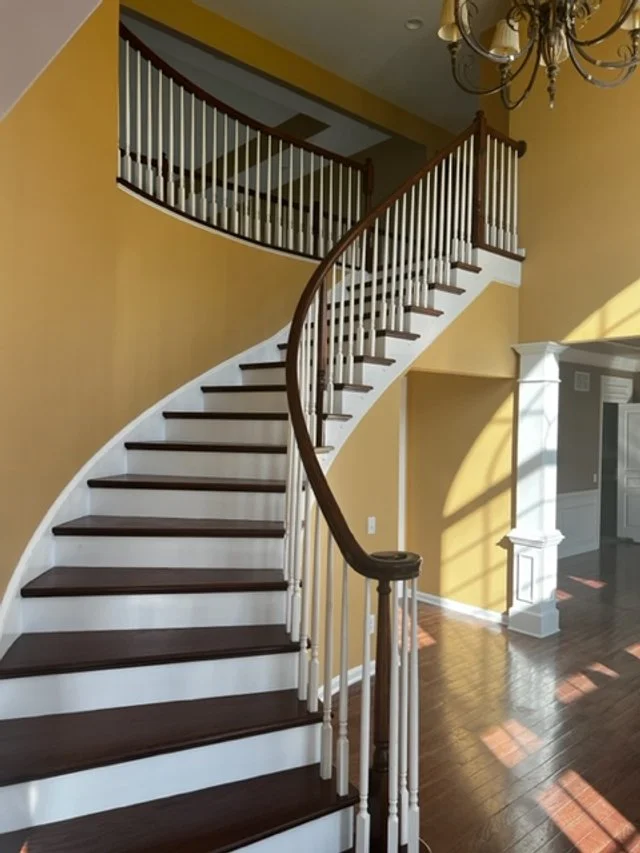
Stair Treads - The horizontal surface you step on. We install solid hardwood treads in any species — red oak, white oak, maple, hickory, walnut, and others — matched to your existing floors or intentionally contrasted for a design effect. Standard widths and custom widths for older stairs with non-standard dimensions. Bullnose or square-edge profile depending on your existing stair style and preference.
Risers - The vertical face between steps. Can be stained to match your treads, finished in a contrasting species, or painted — most commonly white for the clean contrast look that's become the dominant stair aesthetic in the Philadelphia suburbs over the past several years. We ensure tight, gap-free seams between tread and riser on every step. No visible gaps, no movement.
Nosing & Trim - The finishing details that make an installation look professional and perform correctly. Proper nosing at the top landing prevents edge wear, provides a clean transition to the upstairs floor, and adds safety. We don't skip trim details.
Carpet-to-Hardwood Stair Conversions One of the most common calls we get throughout the Philadelphia suburbs. Carpeted stairs in a colonial or center-hall that the homeowner wants converted to hardwood — either matching the existing floors or taking the opportunity to go a different direction with species or stain. We remove the carpet, assess the underlying stair structure, repair or replace anything that needs it, and install the full tread, riser, and nosing system. Most carpet-to-hardwood conversions run 2 to 3 days.

Blue Bell, PA
New Hope, PA
The White Risers Question
It's the most common design decision on stair installations right now and we wrote a full breakdown on it — white painted risers versus matching stained risers, what works in which homes, and what to consider before you commit. If you're deciding between the two, read it before you call us. It'll make the conversation more productive and the decision easier.
Read Our Full Article on White Riser vs Matching
The short version: white risers work beautifully in traditional colonials and center-halls throughout Bucks County and Montgomery County where the trim and millwork are white. Matching stained risers work better in contemporary and transitional interiors, and in homes where the stairs are more open and visible from multiple angles. Both are correct in the right context. Neither is automatically better. Stair and floor connection is more than an aesthetic decision — here's why your staircase must match your first-floor hardwood and what happens when it doesn't.
Our Process on Every Stair Job
1. Measurement and consultation first. We measure every tread, assess the existing stair structure, identify any repairs needed, and walk you through design options — species, stain, riser treatment, railing style — before quoting anything. Stair work requires precision from the first measurement forward.
2. Material selection with samples. Species samples, stain samples on actual tread material in your home. You see what it looks like before anything is ordered.
3. Structural prep. Any loose treads, damaged risers, soft spots in stringers, or movement in newel posts gets addressed before finish materials go on. We fix the structure first.
4. Installation. Treads fitted and fastened individually. Risers cut tight with no gaps. Nosing installed and secured. Railing system anchored structurally. Balusters spaced to code.
5. Finishing. Sand, stain, and finish coats on unfinished treads. Prefinished treads get touch-up on cut ends and nosing. Painted risers get floor-grade paint with proper prep — not wall paint, not a single coat. Railings and balusters get appropriate finish for the material.
6. Final inspection. We test every tread for movement, check every fastener, verify railing stability, and walk the completed staircase with you before we leave.
Timeline: Most stair projects take 3-5 days depending on scope.
Stair Work Throughout the Philadelphia Metro
We do stair installations and conversions throughout our full service area — Doylestown, Newtown, New Hope, Blue Bell, Fort Washington, Lansdale, Ambler, West Chester, Paoli, Berwyn, Bryn Mawr, Villanova, Gladwyne, King of Prussia, Elkins Park, Jenkintown, and throughout Bucks County, Montgomery County, Chester County, Delaware County, and Philadelphia.
The photos on this page show recent stair work in West Chester, Bryn Mawr, Blue Bell, and New Hope. Every job is different. Every staircase gets the same standard.

-
Tread-only replacement runs $150 to $300 per tread depending on species and whether the existing riser is staying or being replaced. Full carpet-to-hardwood conversions on a standard 13 to 16 step colonial staircase run $2,500 to $5,000 depending on species and structural repairs needed. We provide free, detailed written estimates with line items before any work begins.
-
Light use after 24 hours. Full cure takes about a week. We'll give you specific instructions based on finish used.
-
Usually yes. Squeaks come from loose treads or structural movement. We identify the source and fix it properly.
-
Depends on your home's style, your trim color, and your personal preference. We wrote a full breakdown on this exact question — read it before your consultation and it'll make the conversation much easier.
-
Yes, if done right. We use durable floor-grade paint and proper prep. They'll need touching up over time but hold up well to normal use.
-
Yes — species and stain matching is a core part of what we do on every stair job. We sample on actual tread material in your home before committing to a color. We'll tell you upfront how close we can get and show you the sample before we proceed.
Ready for an estimate?
Reach out now and find out why we are PA and NJ’s go-to hardwood flooring contractors. Whether it’s installing new or refinishing hardwood floors, we will get it done right the 1st time! Don’t miss out on our discount pricing and exceptional quality. Get in touch today!