
Why Your Staircase Must Match Your First-Floor Hardwood (And How to Get It Right in Bucks & Montgomery Counties)
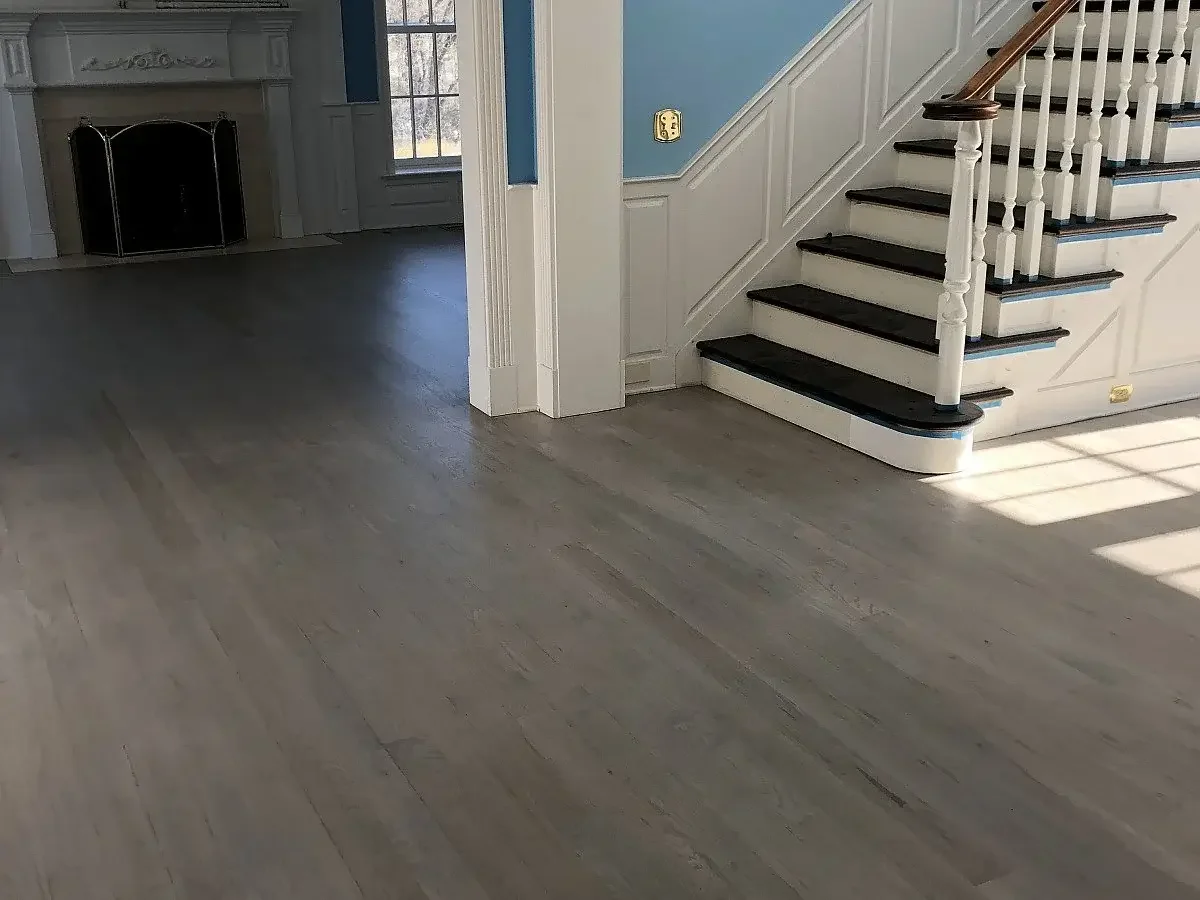
Walk into any home in Wayne, Radnor, Newtown, or Doylestown and the first thing you see is the entryway. Your eyes immediately register two surfaces: the first-floor hardwood and the staircase. When these don't match—when the stair treads are a different tone, the risers clash, or the handrail reads as a completely separate element—the entire space feels disjointed and amateurish.
This isn't about design pickiness. It's about visual coherence that determines whether your home reads as professionally finished or a DIY patchwork. After 20+ years refinishing hardwood throughout Bucks County and Montgomery County, we've seen countless homes where beautiful main-floor hardwood is undermined by staircases that don't match. The fix isn't complicated, but it requires understanding why matching fails in the first place.
The first decision most homeowners face is whether to go with white painted risers or match the treads to the floor — here's the full breakdown on white risers vs matching treads including maintenance, durability, and which works in which homes.
The Entryway as Your Home's Visual Foundation
The entryway establishes the aesthetic standard for your entire home. In traditional colonials common throughout the Main Line, Newtown, and Yardley, the front door opens directly into a foyer with hardwood floors and a central staircase. In open-concept designs popular in newer Ambler, Warrington, and Conshohocken construction, the staircase is often visible from the living room and kitchen.
Either way, the staircase and main floor function as a unified visual plane. The floor is the horizontal surface, the stairs are the vertical extension. When both share the same wood species, stain color, and finish sheen, they create seamless flow. Your eye reads the space as intentional and complete.
When they don't match, the disconnect is immediate. A natural oak floor paired with dark walnut stair treads feels like two different projects cobbled together. White painted risers against honey-toned oak floors can work (we'll get to that), but only when executed with precision. Random mismatches—slightly different stain tones, varying sheen levels, or contrasting wood grains—just look like mistakes.
Why Floors and Stairs Don't Match (Even When You Use the Same Stain)
Homeowners attempting DIY staircase refinishing or hiring separate contractors for floors and stairs often discover a frustrating reality: the "same" stain produces completely different colors on different surfaces. Here's why:
Different Wood Species in Different Components
Your first-floor hardwood is typically one uniform species throughout—red oak, white oak, maple, or hickory. Your staircase, however, is built from multiple materials serving different structural and aesthetic functions:
Stair treads (the horizontal surface you step on) are usually solid hardwood—often oak, but sometimes maple or a different species depending on the home's age and original construction quality.
Risers (the vertical panels between treads) are frequently a different material entirely. In older homes built before 1980, risers might be solid wood matching the treads. In newer construction and many renovations, risers are often poplar, pine, or even plywood—cheaper materials that were originally intended to be painted, not stained.
Stringers (the diagonal supports on the sides) can be yet another wood type, often hidden behind walls or drywall in closed-staircase designs but visible in open staircases.
Handrails and balusters are typically hardwoods chosen for strength and grain appeal—oak, maple, or exotic species like Brazilian cherry—but rarely the exact same grade and cut as your floor planks.
When you apply the same stain to this mix of materials, each absorbs pigment differently based on density, grain structure, and moisture content. The result is a patchwork of tones that don't match each other, let alone your floor.
Grain Direction and Light Reflection
Hardwood floors are sanded with the grain running horizontally. Stair treads have grain running front-to-back (perpendicular to the edge you see). This difference in grain direction affects how light reflects off the surface and how stain settles into the wood.
Even if you're using the exact same species and stain on both surfaces, the grain orientation creates subtle color variations. Under natural light from windows or artificial light from fixtures, floors and stairs can read as noticeably different tones despite being "the same" color on paper.
Vertical vs. Horizontal Surfaces React to Stain Differently
Stain applied to a horizontal surface (your floor) has time to penetrate evenly before excess is wiped away. Gravity keeps the stain in place during the critical first minutes of absorption.
Stain applied to vertical surfaces (stair risers) wants to run and drip immediately. This creates uneven saturation—more stain accumulates at the bottom edge, less at the top. Even with careful technique, achieving uniform color on vertical surfaces requires different application methods and timing than horizontal floors.
Professionals account for this by using conditioners, adjusting stain viscosity, and working in smaller sections with precise wiping schedules. DIYers and contractors who don't specialize in staircases often end up with blotchy, streaky risers that don't match the beautiful even tone they achieved on the floor.
Age and Wear Create Different Starting Points
If you're refinishing existing hardwood rather than installing new, your floor and stairs likely have different wear patterns and existing finish buildup. Floors see foot traffic across their entire surface. Stairs see concentrated wear on the front edge of each tread (the nosing) where feet land with every step.
This means when you sand stairs, the front edges have less material to remove (they've been worn thinner over decades) while the back portions and risers might have thicker original finish. Uneven sanding depth creates uneven stain absorption, even if everything else is identical.
The Professional Approach: How to Guarantee a Match
At Cyclone Hardwood Floors, we treat entryway projects—first-floor hardwood plus staircase—as a single unified job, not two separate tasks. Here's our process for achieving seamless color continuity throughout Bucks County and Montgomery County homes:
Pre-Stain Conditioning for Uniform Absorption
Before stain touches wood, we apply a professional-grade pre-stain wood conditioner to all staircase surfaces. This product partially seals the wood's pores, slowing stain absorption and creating a more uniform base across different wood densities.
Conditioner is particularly critical for:
Mixed-species staircases where treads and risers are different woods
Softwood risers (pine, poplar) that absorb stain much faster than hardwood treads
Older staircases with uneven wear patterns
We allow conditioner to penetrate for the manufacturer-specified time (usually 15-30 minutes), then apply stain while the wood is still slightly damp from conditioning. This prevents the blotchiness and color variation that plague unconditioned multi-species staircases.
Custom Stain Mixing and On-Site Testing
We never rely on off-the-shelf stain colors to match across different surfaces. Instead, we custom-mix stains in small batches, adjusting pigment concentration and carrier ratios to account for the specific woods in your home.
Before committing to the entire project, we perform test patches on inconspicuous areas:
Underside of a stair tread
Back corner of the main floor (under where furniture will sit)
A scrap piece of the actual riser material
We evaluate these tests under your home's natural light at different times of day—morning sun through east windows looks different than afternoon light from west-facing rooms. Only when the test patches match perfectly across all surfaces do we proceed with the full application.
This testing phase adds time to the project but eliminates the heartbreak of finishing everything only to discover the stairs are two shades darker than the floor.
Sanding Technique for Staircases vs. Floors
Floors are sanded with large drum or orbital sanders that remove material quickly and evenly. Stairs require different equipment and technique:
Tread nosings (front edges) are sanded with detail sanders or by hand to avoid over-sanding thin edges that have already lost material to decades of wear.
Flat tread surfaces can handle slightly more aggressive sanding but still require care near the riser transition where wood thickness changes.
Risers are sanded lightly with fine-grit paper—the goal is removing old finish without removing significant wood, since most risers are thin material that can't handle heavy sanding.
Corners and crevices where treads meet risers or stringers require hand-sanding with sanding blocks to reach areas machines can't access.
Our crews have the experience to sand stairs properly—removing enough material to eliminate old finish and imperfections without creating thin spots that will absorb stain unevenly or telegraph through the final finish.
Dust Containment is Critical for Stairs
Sanding staircases generates massive amounts of fine dust that settles into every crevice, corner, and vertical surface. If this dust isn't captured during sanding, it contaminates the stain and finish, creating rough texture and dull appearance.
We use commercial-grade dust containment systems connected directly to our sanders. These capture 99%+ of sanding dust at the source, preventing it from circulating through your home and settling on freshly prepared surfaces.
For the remaining fine dust that escapes, we vacuum every surface with HEPA-filtered shop vacs and wipe down stairs with tack cloths immediately before staining. This level of cleanliness is non-negotiable for achieving glass-smooth finishes that match between floors and stairs.
Finish Application for Vertical Surfaces
Polyurethane finish applied to floors can be brushed or rolled with relative ease—gravity helps it level out before curing. Vertical stair risers require different technique to avoid runs, drips, and uneven film thickness.
We use:
Thinner finish coats on risers to reduce run potential
Faster-drying formulations on vertical surfaces where needed
Careful brush technique that applies finish evenly without overloading the surface
For homes where we're using water-based polyurethane (which doesn't self-level as well as oil-based), we sometimes spray risers and handrails to achieve factory-smooth results without brush marks.
The goal is uniform sheen across all surfaces—floors, treads, risers, handrails—so the entire entryway reads as a cohesive finished product.
When Painted Risers Work (And When They Don't)
Not every staircase needs stained risers matching the treads and floor. Painted white risers with stained treads is a classic design choice popular in colonial and traditional homes throughout the Main Line, Newtown, Doylestown, and surrounding areas.
When white risers work:
Traditional architecture: Colonials, Federals, and Cape Cod styles in Wayne, Radnor, Haverford, and Bryn Mawr where white trim is a period-appropriate design element
Open staircases where white risers create visual lightness and don't close off the space
Homes with significant white trim on baseboards, door casings, and crown molding where white risers unify the palette
Contrast enhancement: Dark walnut or espresso treads paired with crisp white risers create dramatic visual impact
When white risers don't work:
Modern/contemporary homes where all-wood staircases align better with minimalist aesthetics
Rustic or farmhouse styles where painted surfaces feel too formal
Maintenance concerns: White risers show scuffs from shoes, pet scratches, and dirt more obviously than stained wood—fine for meticulous homeowners, frustrating for busy families
Inconsistent trim: If your home's trim is stained wood rather than painted white, white risers clash
If you choose white risers, they must be executed properly: multiple coats of high-quality paint, proper surface prep, and durable finish that won't chip with traffic. Half-hearted painted risers that show brush marks or thin coverage look worse than mismatched stain.
Common Mistakes That Prevent Matching
We've repaired countless staircases where previous contractors or DIYers attempted matching and failed. These are the recurring mistakes:
Using floor-grade stain on stairs without testing: Floor stain formulations are designed for horizontal application on uniform species. Applying them directly to mixed-wood staircases guarantees color variation.
Skipping wood conditioner: This is the #1 mistake. Unconditioned softwood risers absorb 2-3x more stain than hardwood treads, creating dramatic color differences even with identical stain.
Not accounting for lighting: Stairs perpendicular to windows receive different light angles than floors. What looks matched in the can looks different on the wall. Test under actual lighting conditions.
Refinishing floors and stairs separately: When different contractors handle each surface, coordination fails. Slight differences in stain brand, application technique, or number of finish coats create mismatches.
Over-sanding worn areas: Aggressive sanding on thin tread nosings creates depressions that absorb extra stain, appearing darker than the rest of the step. Proper technique preserves uniform thickness.
The ROI of Matching Your Staircase to Your Floor
Matching your staircase to your first-floor hardwood isn't just aesthetic—it's financial. When selling homes throughout Bucks County and Montgomery County, real estate agents know that cohesive, professionally finished entryways create strong first impressions that translate to faster sales and higher offers.
Mismatched or poorly finished staircases create the opposite effect. Buyers notice immediately, mentally categorize the home as "needs work," and either make lower offers or move on to the next property.
The cost difference between mismatched and properly matched floors and stairs is minimal—maybe $500-800 in additional labor for proper conditioning, testing, and coordination. But the value difference at sale time can be $5,000-10,000+ in negotiating power and reduced days on market.
Even if you're not selling soon, living with a professionally matched entryway improves daily quality of life. It's the space you see every time you come home, every time guests visit, every time you walk upstairs. Visual coherence matters.
Our Process for Bucks and Montgomery County Homes
Cyclone Hardwood Floors has refined our staircase and floor matching process over 20+ years working throughout Wayne, Radnor, Newtown, Doylestown, Ambler, Yardley, and surrounding communities. Here's what to expect:
Day 1: Assessment and Planning We evaluate your existing floors and staircase, identify wood species, discuss color preferences, and explain realistic outcomes based on your home's specific materials.
Day 2-3: Sanding and Prep We sand floors and stairs using appropriate equipment for each surface, apply wood conditioner where needed, and prepare all surfaces for staining.
Day 4: Staining We apply custom-mixed stain to test areas, verify color match under your lighting, then stain the entire project in a coordinated sequence that ensures uniform results.
Day 5-7: Finish Application Multiple coats of polyurethane (oil or water-based based on your preference) are applied with appropriate cure time between coats. We protect finished surfaces during this phase to prevent dust contamination.
Day 8: Final Inspection We conduct a walkthrough, address any touch-ups, and ensure you're completely satisfied with the color match and finish quality.
Timeline varies based on project size, but most single-staircase plus first-floor projects complete in 5-8 days.
For the complete picture on what stair installation and carpet-to-hardwood conversion involves, here's our hardwood stair installation service page with process, pricing, and real job photos from throughout Bucks and Montgomery County.
Ready for a staircase and floor that actually match? Contact Cyclone Hardwood Floors for a free on-site assessment. We serve Bucks County, Montgomery County, and surrounding Pennsylvania communities with professional hardwood installation, refinishing, and staircase restoration.
