
Can You Refinish 5/16 Face-Nailed Hardwood Floors? What Homeowners Need to Know
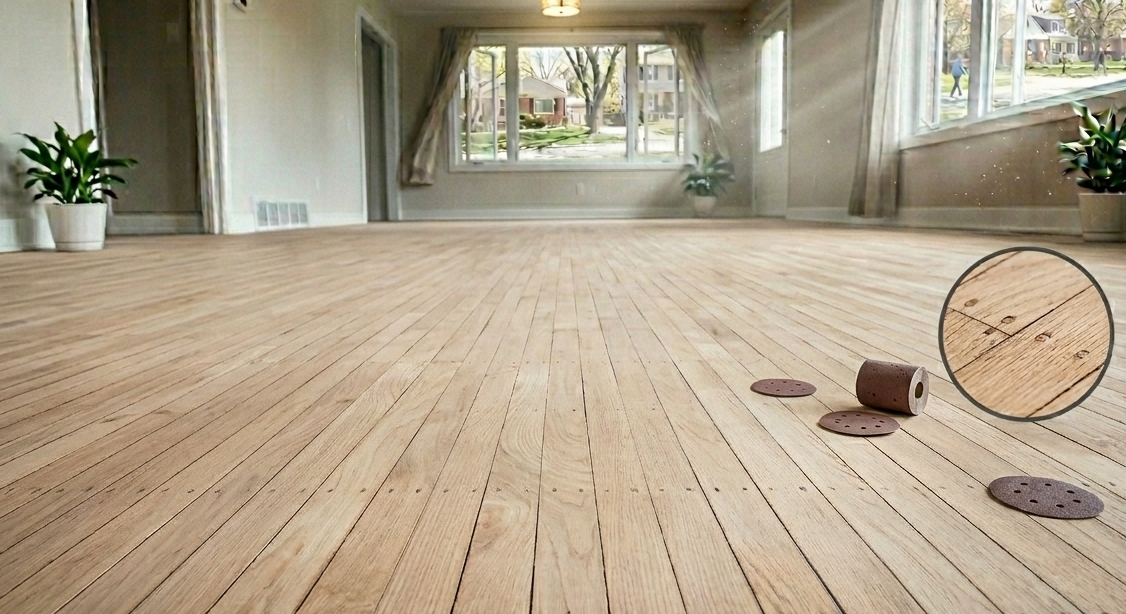
If you've pulled up carpet in an older Pennsylvania home and found thin, face-nailed hardwood underneath, you're asking the right question before doing anything: can these floors actually be refinished, or am I one sanding pass away from ruining them?
The honest answer is: sometimes yes, sometimes no, and the difference matters a lot. Here's what 20 years of working on these floors in Bucks County, Montgomery County, and Delaware County has taught us.
What Is 5/16 Face-Nailed Hardwood and Where Do You Find It
Standard solid hardwood flooring is 3/4 inch thick — that's the dimension most homeowners and contractors picture when they think about hardwood floors. It has a substantial wear layer above the tongue and groove, which means it can typically support four to six refinishing cycles over its lifetime.
5/16 inch hardwood is a different animal. It's roughly half the thickness of standard solid hardwood, and it was commonly installed in two specific scenarios: as a secondary floor over an existing subfloor or finished basement ceiling, where adding the height of a full 3/4 inch floor wasn't practical, and as an economy-grade product in homes built during certain eras when material costs drove thinner specs.
Face nailing is the dead giveaway. Because 5/16 boards are too thin for blind nailing through the tongue — the standard installation method that hides fasteners completely — they're nailed directly through the face of the board, with nails visible on the surface. In most cases those nail holes were filled with putty at the time of installation. Over decades that filler dries out, shrinks, or disappears entirely, leaving the nail heads partially or fully exposed.
You find 5/16 face-nailed floors most commonly in homes built between the 1920s and 1960s, in upper floors over finished spaces, in older row homes and twins throughout the Philadelphia suburbs, and in additions where floor height matching was a priority. We see them regularly in homes throughout Doylestown, Lansdale,Blue Bell, Jenkintown, and the older boroughs of Bucks and Montgomery County.
The Central Question: How Much Wear Layer Is Left
This is the only question that actually determines whether refinishing is viable. Everything else — the nail situation, the gaps, the surface condition — is secondary to this.
A 5/16 inch floor starts its life with roughly 5/16 inch of total thickness. The tongue sits at the bottom of the board, typically consuming about 3/32 to 1/8 inch of that thickness. That leaves you with approximately 3/16 inch of usable material above the tongue — your total wear layer across the entire lifetime of the floor.
Each refinishing cycle removes wood. How much depends on the condition of the floor going in and the skill of the contractor. A light refinish on a floor in decent condition might remove 1/32 inch or less. A heavy cut on a badly worn or cupped floor can remove 3/32 inch or more in a single pass. Do the math and the problem becomes clear fast: a 5/16 floor that has been refinished even once or twice before may be dangerously close to the tongue.
If a sander cuts through the wear layer and hits the tongue, the floor is finished. Literally. The boards lose their structural integrity, gaps open up, and there is no recovery short of replacement.
How to Measure What You Have
Before any contractor puts a sander on a 5/16 face-nailed floor, this measurement needs to happen:
Find a floor register, heat vent, or threshold where the edge of the floor is exposed. Look at the board from the side and measure the distance from the top surface to the top of the tongue. That's your remaining wear layer. If you can't find an exposed edge, a flooring contractor can carefully remove a single board in an inconspicuous area to assess.
Subfloor condition is part of every thin floor assessment — here's the full breakdown on why subfloor problems cause hardwood floor failures and how to diagnose what's actually going on under your floor.
What you're looking for: anything above 1/8 inch of remaining wear layer above the tongue is generally workable with a careful, light sanding approach. Between 3/32 and 1/8 inch is the caution zone — it can be done but the margin for error is thin and the contractor needs to know exactly what they're doing. Below 3/32 inch, refinishing is not recommended. The risk of cutting through to the tongue is too high.
This measurement isn't optional on a 5/16 floor. Any contractor who quotes a refinishing job on thin face-nailed hardwood without checking the wear layer first is either inexperienced or not paying attention. Either way, it's your floor at risk.
The Face Nail Situation
The nails themselves create two specific issues for refinishing.
The first is the nail heads. If the original putty filler has dried and shrunk away from the nail heads over the decades, those heads are now slightly proud of — or level with — the surface. A sanding belt that runs over an exposed nail head can catch, tear, and create a gouge that's difficult to repair cleanly. Before sanding begins, every visible nail head needs to be set slightly below the surface with a nail set and hammer. Time-consuming on a floor with hundreds of face nails, but non-negotiable.
The second issue is the filler. After sanding and before finish application, every nail hole needs to be filled again with a color-matched wood filler. On a natural or lightly stained floor this is straightforward. On a floor receiving a significant color change via staining, the filler needs to be applied after the stain so it can be matched to the final color — otherwise the nail holes show as a different tone from the surrounding wood. This is a detail that separates contractors who've done this work before from those who haven't.
Cupping and Movement in 5/16 Floors
Thin face-nailed floors are more susceptible to seasonal movement and moisture-related cupping than 3/4 inch floors. Less mass means less stability. If you're looking at a 5/16 floor that is cupped — where the edges of individual boards are higher than the center, giving the floor a washboard appearance — that's a moisture issue, not a sanding issue.
Sanding a cupped 5/16 floor flat is a trap. You'll remove the raised edges, the floor will look flat immediately after. But if the underlying moisture condition hasn't been addressed, the floor will re-cup as it continues to respond to the moisture source. You've now spent money on refinishing and the problem comes back — and you've consumed precious wear layer in the process.
The correct sequence on a cupped 5/16 floor is: identify and address the moisture source first. Allow the floor adequate time to stabilize — sometimes weeks, sometimes longer depending on severity. Measure the wear layer after the floor has flattened. Then decide whether refinishing is viable with what's left.
In older Pennsylvania homes with crawl spaces, stone foundations, or moisture-prone basements, this is a real and common scenario. We encounter it regularly throughout Bucks County and Chester County. The moisture source is usually inadequate crawl space vapor barrier, a grading issue directing water toward the foundation, or an older HVAC system creating humidity imbalance. Fix the source first or you're wasting your money on the floors.
Finish Selection for 5/16 Face-Nailed Floors
Assuming the wear layer assessment passes and the floor is stable and ready to refinish, finish selection matters more on a thin floor than a standard one.
Oil-based polyurethane is the traditional choice — durable, warm-toned, long-lasting. The downside for thin floors is that oil-based products require longer cure times and generate significantly more fumes during application. More importantly, oil-based finishes add a measurable film build above the surface of the wood. On a floor already at the limit of its refinishable life, that film build adds negligible thickness but can affect the visual appearance of nail holes and the slight surface relief of older face-nailed boards.
Water-based finishes like Bona Traffic HD are generally the better choice for 5/16 face-nailed floors. They cure faster, have lower VOC emissions, and their thinner film build suits a floor that's already working with tight tolerances. They also provide excellent durability — Bona Traffic HD in particular is a commercial-grade product that performs as well or better than most oil-based alternatives in terms of scratch and wear resistance.
For floors where the homeowner wants a truly natural look that minimizes the appearance of surface irregularities — nail holes, small gaps, slight surface variation — penetrating oil finishes like Rubio Monocoat are worth considering. Unlike film-forming finishes that sit on top of the wood, penetrating oils soak into the fiber of the board and harden there. The result is a floor that looks and feels like bare wood, with no surface film to show wear patterns over time. It's a different maintenance regimen — periodic reapplication rather than full refinishing — but for historic thin floors it's often the most appropriate choice.
When Refinishing Isn't the Answer
Sometimes you measure the wear layer, run the numbers, and the honest answer is that refinishing isn't viable. The floor has been done before, there's not enough material left, and putting a sander on it is more likely to end in replacement than restoration.
In that scenario there are three realistic paths forward. First, replacement in kind — new 5/16 face-nailed hardwood of the same species and width, installed to match the existing floor and finished to blend. In the right circumstances, especially on upper floors where weight and height constraints drove the original thin installation, this maintains the character of the original floor. Second, overlay — installing new hardwood over the existing 5/16 floor using an appropriate profile that manages the height transition at thresholds. Third, full replacement with standard 3/4 inch hardwood if the floor height and subfloor conditions allow it.
We'll tell you which option makes sense for your specific situation. We're not going to sand a floor that shouldn't be sanded and hand you a bill — and we're not going to recommend full replacement when refinishing is viable. Neither of those approaches serves you and neither of them is how we've been working in this market for 20 years.
Once you've confirmed the wear layer can support another refinishing cycle, here's exactly what the process involves and what a realistic lifespan looks like for your specific floor — how long hardwood floor refinishing lasts.
The Bottom Line
5/16 face-nailed hardwood floors can absolutely be refinished — but they require a specific assessment, a lighter hand, nail prep that most contractors skip, and honest wear layer measurement before anyone commits to a scope of work. The floors that get ruined are the ones where a contractor assumed, didn't measure, and found out too late.
If you have 5/16 face-nailed floors in your Bucks County, Montgomery County, Chester County, or Philadelphia home and you're trying to figure out whether refinishing is viable, call us. We'll walk the floor, take the measurements, and give you a straight answer before you spend a dollar.
Frequently Asked Questions
How do I know if my hardwood floors are 5/16 inch? The surest way is to find an exposed edge at a threshold, register, or vent and measure the board thickness. Face nails visible on the surface are a strong indicator — standard 3/4 inch floors are blind-nailed and don't show fasteners. If you're not sure, a flooring contractor can assess it in about five minutes.
Can 5/16 floors be refinished more than once? Possibly — but it depends entirely on how much wear layer remains above the tongue after each refinishing cycle. There is no blanket answer. Each floor needs to be measured individually before any refinishing decision is made.
Is face-nailed hardwood inferior to blind-nailed hardwood? Not necessarily in terms of the wood itself — the species and milling quality of older face-nailed floors is often exceptional. The limitation is simply that the installation method was required by the thin profile, which limits future refinishing potential.
What does it cost to refinish 5/16 face-nailed floors? In our market — Bucks County, Montgomery County, Chester County, and Philadelphia — expect $3.50 to $5.50 per square foot for 5/16 face-nailed refinishing, slightly higher than standard 3/4 inch refinishing to account for the additional prep work involved with nail setting and filler application. We provide free, detailed written estimates.
How long does refinishing 5/16 floors take? Timeline is comparable to standard refinishing — typically 3 to 5 days for a typical home, depending on square footage and condition. The additional nail prep adds time on the front end but doesn't significantly extend the overall project duration.
Cyclone Hardwood Floors LLC has served Bucks County, Montgomery County, Chester County, and Philadelphia for over 20 years. We specialize in hardwood floor installation and refinishing including historic and specialty floor types. Serving Doylestown, Lansdale, Blue Bell, Newtown, Ambler, Jenkintown, West Chester, Berwyn, Villanova, and surrounding communities. Contact Us here or Call or text (484) 253-5348.
