
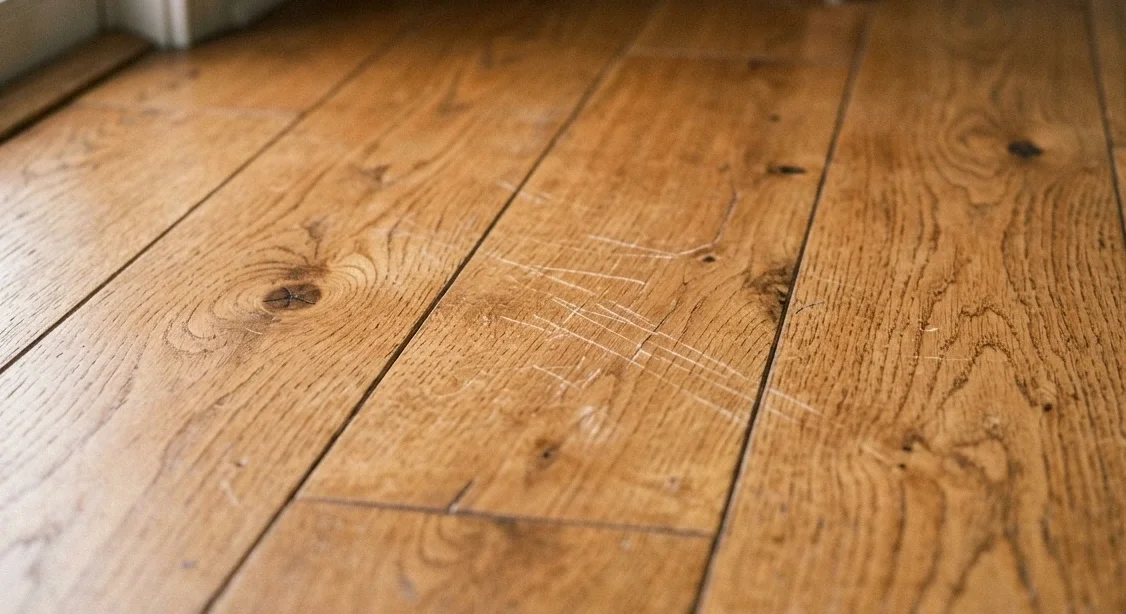
Walk into any flooring showroom in Bucks County, Montgomery County, or anywhere else in the country and you'll hear some version of the same line. Aluminum oxide finish. Commercial grade. Scratch resistant. The most durable finish available.
All of that is technically true. None of it means what most homeowners think it means.
Scratch resistant is not scratch proof. It never has been and no finish technology currently available makes it so. After 20 years of installing and refinishing hardwood floors throughout the Philadelphia metro — and getting called in to fix the ones that didn't meet expectations — here's the honest version of what prefinished finish does, what it doesn't do, and what that means before you spend $12,000 on a floor.
What Aluminum Oxide Actually Does
Aluminum oxide is a hard mineral compound added to factory-applied urethane finish during the manufacturing process. It genuinely increases the hardness and abrasion resistance of the finish surface compared to standard site-applied polyurethane. That's real. It's not marketing fiction.
What it means practically: aluminum oxide finish resists the micro-abrasion from everyday foot traffic — dirt, grit, fine particles tracked in from outside — better than a standard site finish. The finish holds its sheen longer under normal use. In a low to moderate traffic household without pets, a quality prefinished floor with aluminum oxide finish can look good for 10 to 15 years without refinishing.
What it doesn't mean: the finish is impervious to scratching. Aluminum oxide raises the threshold at which scratching occurs. It does not eliminate it.
What Urethane Can and Can't Do — Regardless of What's In It
This is the conversation that almost never happens in a showroom because it doesn't help sell floors.
Urethane finish — site-applied or factory-applied, oil-based or water-based, with or without aluminum oxide — is a surface coating. It sits on top of the wood. It protects the wood from moisture, staining, and abrasion up to the limits of its hardness. Beyond those limits it scratches, dents, and wears.
Those limits are lower than most homeowners expect because the things that scratch hardwood floors aren't exotic. A dog's nails scratch prefinished aluminum oxide finish. A piece of grit tracked in on the bottom of a shoe scratches it. A chair leg dragged across the floor scratches it. A dropped key scratches it. None of these are unusual events in a normal household and none of them care how much aluminum oxide is in the finish.
The difference between a standard site finish and an aluminum oxide prefinished product is the number of events required to produce a visible scratch — not whether scratching is possible. More resistant. Not immune.
The Thickness Problem Nobody Mentions
Here's the specific technical issue with prefinished floors that showrooms consistently gloss over.
Factory-applied finish on prefinished hardwood is applied in multiple thin coats — typically 6 to 10 coats of aluminum oxide enhanced urethane — and cured under UV light in a controlled factory environment. The total finish film build is thinner than most homeowners assume and significantly thinner than a properly applied site finish in some cases.
More importantly the finish is applied before the boards are installed. Every cut end, every fastener hole, every gap between boards — every place where two boards meet — is either unfinished or minimally finished. The joints between prefinished boards are the most vulnerable point on the entire floor and they're the first place you see wear, moisture penetration, and damage in high traffic areas.
A site-finished floor — sanded, stained, and finished after installation — has finish applied across the entire continuous surface including the joints between boards. The finish film is thicker, applied in fewer coats over a properly prepared substrate, and cures as one continuous surface rather than individual boards butted together. Here's the full breakdown on how oil-based and water-based site finish compares for Pennsylvania homes and why finish application method affects durability.
The Species Underneath Still Matters
Finish resistance is only half the picture. The other half is the wood underneath the finish.
A scratch that penetrates through the finish layer reveals the wood. On a hard species like hickory at 1820 Janka the exposed wood is dense and slow to show wear. On a softer species like pine at 380 to 870 Janka the exposed wood is soft and damaged easily. The finish is the first line of defense. The species is the second.
Aluminum oxide finish on a soft species gives you better surface protection than standard urethane on the same wood — but it doesn't make the wood harder. Once the finish is breached the underlying species determines what happens next. This is why prefinished soft species floors with impressive finish specifications still show wear and damage faster than site-finished hard species floors with standard polyurethane. The marketing leads with finish hardness. The performance is determined by the whole system.
What This Means Before You Buy
None of this means prefinished hardwood is a bad product. It's not. Quality prefinished hardwood from a reputable manufacturer installed correctly performs well in the right application. Here's what to take away from this before you make a decision.
The scratch resistance claims are real but relative. A prefinished floor with aluminum oxide finish will scratch less under normal use than a standard site finish on the same species. It will still scratch under normal use.
The same aluminum oxide finish that resists scratching also makes prefinished floors significantly harder to refinish — here's why refinishing prefinished hardwood is a different and more demanding job.
Your household determines which product is right. A retired couple in a low-traffic Doylestown colonial with no pets can get 15 years out of a quality prefinished product without issue. A family in a Blue Bell colonial with two labs and three kids will see scratch evidence on the same floor within two to three years regardless of finish specification.
Maintenance habits matter more than finish specification. Keeping grit off the floor — the single biggest source of scratch damage — through consistent dust mopping and entry mats does more to protect a prefinished floor than the difference between aluminum oxide grades. Here's the complete guide to hardwood floor cleaning and maintenance mistakes that accelerate finish wear.
The refinishing question is different for prefinished floors. Many prefinished products have a thinner wear layer than solid site-finished hardwood. Before purchasing any prefinished product confirm the wear layer thickness and understand how many refinishing cycles it supports. A prefinished engineered product with a 2mm wear layer cannot be refinished. A prefinished solid product with standard 3/4 inch thickness can be refinished multiple times but the factory finish requires specific preparation before new finish will adhere properly. Here's everything you need to know about wear layer thickness and refinishing longevity in engineered and prefinished products.
The Honest Bottom Line
Scratch resistant finish is a real improvement over standard urethane. Aluminum oxide is a real technology that genuinely extends finish life under normal residential use. No finish currently available — factory or site applied, aluminum oxide or ceramic — makes a hardwood floor scratch proof.
The floor that holds up best in your specific household is determined by species hardness, wear layer thickness, installation quality, maintenance habits, and realistic expectations about what hardwood floors are — a natural material that records life. Not a surface engineered to be impervious to it.
If you're deciding between prefinished and site-finished hardwood for a Pennsylvania home — or trying to understand what your current prefinished floor can realistically handle — call us. We install both, refinish both, and give you the straight answer based on your actual household before you commit to anything.
Frequently Asked Questions
Are prefinished hardwood floors more durable than site finished? In some ways yes, in some ways no. Aluminum oxide enhanced prefinished finish resists micro-abrasion from foot traffic better than standard site-applied polyurethane. But site-finished floors have finish applied across the full continuous surface including board joints — which is a durability advantage in high-traffic areas where joint gaps are a vulnerability in prefinished products. The honest answer is that a quality site finish applied correctly on a hard species in a properly prepared installation performs comparably to or better than most prefinished products in real residential conditions.
Why do my prefinished hardwood floors scratch so easily? Because scratch resistant doesn't mean scratch proof. The aluminum oxide finish reduces but doesn't eliminate scratching. The most common culprits are grit and fine particles tracked in on shoe soles — the most abrasive thing that contacts your floor surface daily. Consistent dust mopping and entry mats at exterior doors reduce this significantly. Pet nails are the second most common cause — keep them trimmed.
Can scratched prefinished hardwood floors be refinished? Yes — but with specific considerations. Factory finish requires abrading or chemically preparing the surface before new finish will adhere properly. Standard screening doesn't cut through aluminum oxide finish effectively. A full sand-back to bare wood removes the factory finish entirely and allows conventional refinishing. The wear layer thickness of your specific product determines how many times this is feasible.
Is aluminum oxide finish worth the premium price? For moderate traffic households without large dogs — yes. The extended finish life in normal use justifies the cost difference over standard urethane. For high-traffic households with multiple large dogs, kids, and heavy use — the premium buys you some time but doesn't fundamentally change the outcome. Species selection and maintenance habits will matter more than finish specification in those households.
What is the most scratch resistant hardwood floor available? The most scratch resistant combination is a hard species — hickory at 1820 Janka or Brazilian Cherry at 2350 if you're considering exotics — with a quality two-component water-based site finish like Bona Traffic HD. Hard species resists penetration once the finish is breached. Two-component finish resists the breach longer. Neither is scratch proof. Together they're the most resilient combination available in residential hardwood flooring.
Cyclone Hardwood Floors LLC has served Bucks County, Montgomery County, Chester County, Delaware County, and Philadelphia for over 20 years. We install and refinish hardwood floors throughout the Philadelphia metro. Contact Us Here or Call or text (484) 253-5348.
